Laws of Nature

Did you see that sunset last night? It was so beautiful that when I was driving from Waynesboro heading west, I was distracted by it, and nearly ran off the road in my neighborhood. This morning’s sunrise was the same way. I found myself wanting to watch it rather than do any reading (or imagewriting, for that matter).

G. K. Chesterton writes that creation is God’s gift to us. We all delight in different things. I love geese and enjoy the sound of them calling out to each other as they fly overhead in formation. I enjoy the smell of fresh-cut grass and the smell of the woods in autumn. I love to feel sand between my toes and hear the sound of crashing waves at the beach. I even like the silence after a fresh snowfall. I’d bet that you love some of those things, too. They are gifts from God to us.

Chesterton writes that although the sun probably will rise tomorrow, it doesn’t have to. Perhaps God says, “Arise! Go forth!” each day. He goes on to say that grass didn’t have to be green. God could have made it purple if he wished. There are no real “laws” of nature, without God putting everything in motion and holding it all together as Colossians 1:16-17 says. God can do whatever he wants. He makes frogs jump and birds fly and water runs downhill not because of laws, Chesterton writes, but because God wishes them to do so. He says, “It is not a necessity, though we can count on it practically, we have no right to says that it always must happen.”

As you walk outside today, wherever you are, take notice of the fabulous gift God has given you today. Smile and give thanks.

Excellence, Bliss, and Success…

“Be all that you can be.” That is (or was) the advertising slogan for one of the branches our armed services. You’ve seen the commercials. But have you heard that advertising slogan repeated on Sunday mornings in pulpits? I’ll bet you have.

The Christian life is sometimes portrayed in a similar vein, where you can be all that God wants you to be and accomplish all you are designed and destined to accomplish. The Christian life is sometimes represented as some kind of self-improvement program or the pathway to moral excellence, marital bliss, successful child-rearing, or professional and financial windfall. Maybe it’s done subtly and by accident, but in many cases, that is the impression given to not only the watching world, but those within the church.

Coupled with that impression is the implication that by trying harder, re-doubling your efforts, focusing more, re-prioritizing, “stepping up to the plate”, or “going to battle” will result in the excellence, bliss, and success you’re aiming for.

Those are the impressions I have after 18 years of “trying” to be a Christian. But recently, I’ve had to ask the question, “Where is the Good News in that? In the pursuit of holiness, which will presumably result in excellence, success, and bliss, where do I find good news?”

I had to start at the beginning. Not Genesis 1:1, the beginning of the Bible, but John 3:16, the essence of the Gospel. “For God so loved _______…” Fill in your name here. For God so loved you and me that He sent his only Son so that we wouldn’t perish, but instead experience eternal life. That’s not just life after death, but REAL life BEFORE death! And that’s no ordinary love, but an extraordinary kind of love that accepts you and me right where we are. We don’t have to strive. We don’t have to try to improve. We don’t have to achieve.

Living with this freedom doesn’t make me lazy spiritually, or give me a license to live any way I please. On the contrary, it frees me to live for God utterly and completely. I don’t have to; I want to! It just happens.

The excellence, bliss, and success will come, but it may not look like we picture it. Instead, it will be real excellence, real bliss, and real success, and it will come as a (super)natural outpouring of the freedom found in Christ. It also may come because of, in spite of, or in the form of failure, turmoil and tragedy, and defeat and suffering.

“For God so loved…” It’s the kind of love that can be trusted… trusted with every fabric of my being. I can trust Him to work for my good, no matter what. It’s a kind of love that brings real freedom to let go. I can trust and let go because He’s got this covered and He’s got my back.

I am a child of God, with Christ living in me, and I live in the unshakeable Kingdom of God.

That’s Good News!

“While we were…”

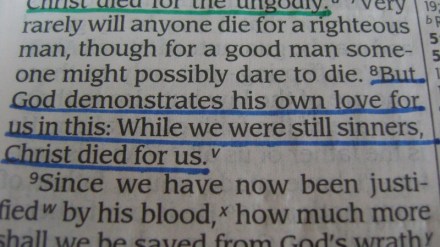
But God demonstrates his own love for us in this: While we were still sinners, Christ died for us. (Romans 5:8)

I am constantly amazed at that verse. “While I was a sinner…” And I think back to my days B.C…. before Christ. I think of all the things I did in living to please myself. I was so selfish. I was despicable. I hurt many people in many ways. I did terrible things.

And yet Christ died for me… while I was a sinner. Yes, I know it was thousands of years before I was born, but since time is eternal to God and He can see the eternal past and the eternal future, he could see me getting drunk, forgetting where I parked my car, passing out with my clothes on, and yet He died for me! Amazing!

And because of time-eternal, He can see me now, still a sinner (although now not a slave to sin) desperate for His grace to even take another step. He sees me struggling and failing, time after time, in word, in thought, or in deed. “While I was a sinner…”, God demonstrated his love, Scripture says. He loved me first. And He still loves me first.

James Bryan Smith says in his book, Embracing the Love of God:

“God does not love. God IS love. (1 John 4:16) I am capable of loving but I am also capable of not loving. That cannot be said about God. God cannot stop loving, because love is God’s nature.”

If I blow it again… if I fail for the 23rd time (or the 93rd time) at the same thing… God does not stop loving me. In fact, God loved me first and continues to love me first (1 John 4:19). He loves me. He accepts me. He smiles when he looks at me (Numbers 6:26) and thinks about me. I am the apple of his eye. (Psalm 17:8) And as I’ve said so many times before, he takes great delight in me and even sings over me (Zephaniah 3:17).

But (obviously) it’s not just me. “While WE were still sinners…” the verse says, “God demonstrated his own love for us.”

It’s a promise for all of us.

The deepest chasm…

“Religion is the human search for God; Christianity is God’s search for humans.” — James Bryan Smith

Have you ever seen the ceiling of The Sistine Chapel? I haven’t either – personally – but I’ve seen pictures. One of the amazing paintings by Michelangelo is The Creation of Adam, depicting Adam reclining and reaching toward God. God, surrounded by angels, in turn is reaching down from heaven toward Adam. They reach and reach, seemingly straining toward each other and are only separated by what seems like an inch.image

Except that inch would later become a chasm of endless width, breadth, and depth. It is filled with my deepest, darkest thoughts. It is filled with my most wicked acts and deeds. It is filled with secrets. It is filled with sin. My sin. Your sin. Our sin.

In His great love for us, God gave us the gift of eternal living through the death and life of His Son, Jesus Christ. He came to us. He wanted us. He made a way. We owe it all to Him. We didn’t go looking for Him. While we were still sinners, Christ died for us. We were stuck drowning in our own chasm of darkness. It’s all His doing. We have tried reaching for Him for millenia. In one instant, He reached out for us and bridged the widest canyon in human history.

And He still is reaching for us today.

That’s why it’s called the Good News.

(Thanks to my friend Nancy Jo for posting in Facebook the short sentence at the top of this post. It’s from the book we’re all reading at church written by James Bryan Smith. Actually, over 250 people are reading from the same chapter of the same books each week for the past nine months, and that is a powerful thing. Lives have been changed… mine included. I highly recommend them. You can find them HERE.)

Conversations with God…

This morning I didn’t know what to read or where to start, so I prayed, “Lord, what’s on your mind today? What’s on your heart today? I want your thoughts to be my thoughts. Show me what you want this morning.”

I then prayed for my friends Donna and Amanda, brave women enduring a lot and glorifying God while doing it. I then opened a devotional book and the day’s devo talked about unity with God and His will, not becoming double-minded with hidden motives or agendas.

Then I looked at a pamphlet that one of my favorite authors wrote, entitled, “Reading With Your Ears – How to Hear the Voice of God in the Bible.” It’s basically a study guide teaching how to read the Bible conversationally. He begins by saying,

“Have you ever stopped to think how amazing it is that God wants to talk to you? The creator of the universe, God Almighty himself, wants to talk to you! He loves you. He is concerned about every aspect of your life. He has something to say to you every day. And he wants to hear from you every day, too. As followers of Christ, we can all have conversations with God. We just need to learn how to listen.”

He goes on to talk about how to read the Bible conversationally, and encourages to read “for depth, not distance.” Find a passage, either by using a devotional, the material from Sunday’s sermon, or one you’re fond of, and read it. It shouldn’t be overly lengthy, nor – if you’re just starting out – difficult passages. (Difficult to understand, difficult to pronounce, difficult to read)

Read it once all the way through. Then read it again, stopping at anything that catches your attention. Read it emphasizing certain words, then read it again, emphasizing different words. Reading it aloud helps here.

Then let it seep in. “Let the word of Christ dwell in you richly.” (Colossians 3:16) Be a hot cup of water and let the Word be a tea bag. Let it steep and allows its color, flavor and aroma to saturate you. Ponder the meaning of words. Let the Holy Spirit guide your thoughts. Let your mind wander but be mindful of what you’re thinking about. If thoughts about today’s work or activities pop up, have a pad of paper handy to write those thoughts down and then come back to the Word.

I did that this morning, and went back to the calling of Matthew, the tax collector, in Matthew 9. I wrote about his encounter with Jesus yesterday, but just felt the passage might hold more for me. As I read the end of the scene, Jesus says in verse 13,

“But go and learn what this means: ‘I desire mercy, not sacrifice.’ For I have not come to call the righteous, but sinners.”

In my Bible, there’s a footnote after the sentence, “I desire mercy, not sacrifice” and it refers me to another verse, Hosea 6:6 in the Old Testament. Jesus just said, “Go and learn what this means,” so I turned to the passage.

Hosea is a prophetic book that talks about the “adulterous” people of Israel, who walked away from the God of their forefathers, pursued other gods, or were just going through the week-after-week motions of their religious lives. They may have gone through their daily or weekly rituals, going to the synagogue, singing their songs, praying their prayers, and making their sacrifices, but their hearts weren’t in it. Sound familiar?

And then God speaks through the prophet and says:

O Israel and Judah, what should I do with you? asks the Lord.
For your love vanishes like the morning mist and disappears like dew in the sunlight.
I sent my prophets to cut you to pieces – to slaughter you with my words,
with judgments as inescapable as light.
I want you to show love, not offer sacrifices.
I want you to know me more than I want burnt offerings.
(Hosea 6:4-6, NLT)

The Message paraphrases verse 6:

I’m after love that lasts, not more religion.
I want you to know God, not go to more prayer meetings.

Today’s message to me: God wants me to know Him more. He wants to talk to me. He wants me to know His thoughts and His heart.

He wants to have a conversation. I need to (re)learn how to listen.

Acceptance is a powerful thing…

I visited another church Sunday and the pastor delivered an excellent sermon built around the calling of Levi in Matthew 9. Levi, of course, is Matthew, the writer of the gospel. He was tax collector when Jesus encountered him on the road at his “toll booth.” The pastor pointed out that Matthew, as a tax collector, was hated by his own people, the Jews, not only because he was working for the IRS, but in those days, he was seen as a traitor because he was working for the Romans who occupied the region at the time. He also cheated and extorted money to make his living. He charged an exorbitant amount at his toll booth, and, most likely, was wealthy (and despised) because of it.

He was no doubt a loner. He had “friends”, if you want to call them that, but they were fellow tax collectors and other riff-raff who couldn’t be trusted. I’m not sure Matthew would call them real friends. So when Jesus comes along, and invites Matthew to come along with him, Matthew had to be looking around behind him and saying, “Who? Me?!?” You’d think there was more interaction between Matthew and Jesus during this encounter, but if there is, it doesn’t show up in Matthew’s gospel, nor the two other gospels where this story also appears. Matthew simply gets up, leaves his toll booth behind, and joins Jesus.

As the pastor shared, acceptance is a powerful thing. It pulled Matthew from his toll booth. It pulled him away from his old life in an instant, without any reasoning or convincing. Acceptance is a powerful thing. As the pastor continued, he said it’s acceptance that convinces youngsters to join gangs. It’s acceptance that makes peer pressure so powerful. Acceptance is a powerful thing. Just ask Levi the (former) tax collector.

Knowing that God accepts you no matter where you are in life, no matter what you’ve done, no matter how you’re doing in your journey with God… if you’re riding high or down in the depths… on the mountaintop or weeping bitterly… knowing that God accepts you and loves you… well, it has the power to transform you. It did me.

When I discovered in my heart what I knew in my head: that God loved me and accepted me when I succeeded and when I failed… when I prayed a lot or when I prayed very little… when I go to church every single week and say “yes” to every invitation to serve or help or when I skip church, spend time home alone with family… that no matter what, He loves and accepts me, it brought new freedom into my life. As I’ve said before, not freedom to live my life selfishly or lazily, but freedom to trust God with every fabric of my being. It is a freedom from performancism (is that even a word?) that makes me so grateful, I naturally want to seek more of God.

All God wants is for us to come. He invited Matthew that day along the roadside. And he invites you and me.

Acceptance is a powerful thing. Just ask Matthew… or me.

Gone ’round the bend

I know some of you think I’ve “gone ’round the bend”, because I keep posting about this “new” or “fresh” encounter I’ve had with God’s love. It is an encounter with the finished work on the Cross by Jesus. It is the love of Jesus that has changed me.

But some of you think I’ve gone crazy. You think I’m nuts because I keep posting stuff like:

“Because Jesus won, I’m free to lose.
… because Jesus was strong, I’m free to be weak.
… because Jesus was someone, I’m free to be no one.
… because Jesus was the ultimate leader, I’m free and content to be a follower.
… because Jesus was (is) extraordinary, I’m free and content to be ordinary.
… because Jesus succeeded, I am free to fail.
… because ‘It is finished’, the work is done.
There is such freedom in those words, but there’s more. I’ve said it before but I have to say it again and again because it is such Good News: There’s nothing I can do to make God love me more and nothing I can do to make God love me less. There is nothing I can do to repay God. There is nothing I can do to curry God’s favor, including surrendering more.” (Posted May 3rd)

And…

“All of us so easily fall into a trap of measuring our own righteousness. We measure it by how much we pray. We measure it by how much we read our Bibles. We measure it by our behavior day-by-day. We measure how we talk, what we drink, and even by how much or what we eat. We measure ourselves against others. But when we measure, by definition, we are self-righteous. We become legalists. We become like the Pharisees in Jesus’ day.” (Posted May 15)

Because I said these things, those of you who know me think I’ve fallen off the doctrinal wagon. Some may think that I’m espousing some kind of radical license to sin or to be lazy. Some may even think that I have fallen into some kind of sin; otherwise why would I talk about grace so often?!?

I’m not saying:

Don’t pray.
Don’t read your Bible.
Don’t go to church.
Don’t serve in the Kingdom somewhere.
Don’t be grieved when you sin because you’re going to heaven anyway.

What I am saying is that my (and your) only hope is Jesus. If we truly understand what Jesus has accomplished on the Cross, we are set free from the pressure of striving and trying so hard to “be a Christian.”

Once we really understand the love that God has for us in Jesus, we are free to fully and completely trust Him. We pray because we want to know Him more. We read our Bible to know His character (John 1:1, Hebrews 1:1), His truth (John 14:17), His instruction and His correction (2 Tim 3:16). We go to church because that is where we find community with like-minded Jesus-followers. We serve because that is how we show the love of God to those outside our community who so desperately need it.

We don’t do those things because it’s our duty or we need to repay God, but in doing them, we know God more fully. And knowing God more fully is what you WANT to do when you truly understand what God has accomplished just for you and me in Christ at the Cross. Desiring to know God more fully just simply flows from a life which understands the freedom and victory the Cross has brought.

Lastly, some may think that I’ve adopted some form of “once-saved, always-saved” doctrine. Those four words have come to mean something else than what was originally intended. They’ve come to negatively portray a theology of license. In other words, once you’re saved by grace, you’re free to live any way you want, because God’s grace will forgive you in the end. The apostle Paul makes it clear that simply isn’t true in Romans 5:20-6:7. Instead, those four words “once-saved, always-saved” or the words, “eternal security” should bring freedom and take the pressure off. Once you truly understand the love of God in Christ and truly embrace the work done there, you don’t want to live any way you want. You want to live any way GOD wants. If you or I are living another way, then I wonder if we truly understand God’s love.

So… have I gone ’round the bend? Yep.
Have I gone crazy? You better believe it.

I have encountered the good news of the Good News. If you find that you feel worse leaving church than when you entered, something’s wrong. You need the Gospel. It brings freedom. It takes the pressure off. It’s brings joy and peace like never before.

And you’ll want to tell everyone.

May I never boast except in the cross of our Lord Jesus Christ, through which the world has been crucified to me, and I to the world. (Galatians 6:14, NIV)

If it seems we are crazy, it is to bring glory to God. And if we are in our right minds, it is for your benefit. Either way, Christ’s love controls us. Since we believe that Christ died for all, we also believe that we have all died to our old life. He died for everyone so that those who receive his new life will no longer live for themselves. Instead, they will live for Christ, who died and was raised for them. (2 Corinthians 5:13-15, NLT)

Keeping Score

Have you ever played a game and not kept score? Maybe it was pick-up basketball game or a round of golf. I was reading in Galatians this morning and I thought of what it was like playing without keeping score.

Some folks like it. They like the freedom of not having to keep score while letting “it all hang out” on the playing field or the basketball court. It helps them perform better. Personally, I don’t like it. I’m not wired that way.

I like keeping score. I like measuring my performance, whether it’s trying to lower my score playing golf or beating the other player in Madden NFL video game. I like competition. I like keeping score. Most of us do. It’s built-in. It’s why sports are so popular worldwide.

We naturally want to measure our performance. We do it in sports and in school. This week, children are taking SOLs… and being measured against Standards of Learning, benchmarks of performance. They’ll continue to keep score of their performance by the grades they get and the scores they receive, and some of their lives will seemingly hang in the balance when they take their SAT tests late in their high school careers.

We also tend to do it in our religious life. We measure our devotion by how much we read our Bibles, how often we go to church, and how much time we spend in prayer. Not all of us do that, mind you, but those who like to keep score certainly do. I should know. I’m one of those people.

But a fresh encounter with grace has freed me from that and I truly am free! I was reminded of it again as I read a passage in Galatians:

Yet we know that a person is made right with God by faith in Jesus Christ, not by obeying the law. And we have believed in Christ Jesus, so that we might be made right with God because of our faith in Christ, not because we have obeyed the law. For no one will ever be made right with God by obeying the law.” For when I tried to keep the law, it condemned me. So I died to the law-I stopped trying to meet all its requirements-so that I might live for God. My old self has been crucified with Christ. It is no longer I who live, but Christ lives in me. So I live in this earthly body by trusting in the Son of God, who loved me and gave himself for me. I do not treat the grace of God as meaningless. For if keeping the law could make us right with God, then there was no need for Christ to die. (Galatians 2:16,19-21 NLT)

The requirements of keeping score are exhausting. But thank God His grace is inexhaustible! I don’t need to keep score. I don’t need to keep track of how often I read my Bible or how long I pray or how many weeks in a row I’ve been to church or how often I’ve served in the church nursery. Now all those things happen (super)naturally, because Christ lives in me, as Paul says in the passage above. Grace doesn’t give me reason to be lazy or give me a license to sin, but it frees me to live for God fully and freely, loving him and others extravagantly.

The only score that matters is: JESUS 1 SIN/DEATH 0

Holy love meets holy fear

I have a friend that I’m praying for this morning. He is struggling in his faith. He is struggling with apathy toward the things of God. He wants more but he doesn’t know how to get there. He wants God to light a fire in him. He says he doesn’t really have any besetting sin in his life, any sin that he seems to fall into time after time. He just seems stuck in neutral, he says. Sound familiar? It does for me.

I was in that place recently. It took a fresh encounter with God’s love to show me the meaning of His grace toward me (and you) that drew me to Him and ignited a flame within me to tell others about it. I want to tell everyone about the finished work of the Cross and the true freedom found there. I’ve been posting about it for weeks. You can read more at FaithOnTheRoadAgain.com. But back to my friend…

I have him reading some things, hoping he’ll have a fresh encounter with God’s love, too, but he wrote to me after reading a chapter and he said that he thought he had full, mature understanding of the grace of God. Instead, what he thought he needed was a healthy fear of God. I’m trying to discover what he meant. I just sent him an email asking him, telling him that I’m praying for him. Thirty seconds later (literally!), he sends me one, saying that he’s praying for me! I love how God works!

Anyway, I wonder what “fear of God” means to him. Does he want to be “scared straight”? Does he need “shock therapy”? Or does he need a full revelation of the fullness and awesomeness of God? How do you get to the place of being filled with holy reverence and awe toward God, which would define a “healthy fear of God”?

Could it be that what he and I are talking about are the same things? Could it be that a full revelation of the love and grace of God toward me, you, and the rest of humanity is the same thing as the “fear of God”? Most people would think not, but I’m not so sure this morning.

As I watch the amazing colors of the sunrise this morning, I’m reminded that His mercies are new every morning. That’s what the Bible tells us. I turned to that passage in Lamentations. Its author, the prophet Jeremiah, is grieving over the destruction of his beloved city, Jerusalem. It lies in ruin. Here is what he says:

He has walled me in so I cannot escape; he has weighed me down with chains. Even when I call out or cry for help, he shuts out my prayer. He has barred my way with blocks of stone; he has made my paths crooked. Like a bear lying in wait, like a lion in hiding, he dragged me from the path and mangled me and left me without help. He drew his bow and made me the target for his arrows. He pierced my heart with arrows from his quiver. I became the laughingstock of all my people; they mock me in song all day long. He has filled me with bitter herbs and given me gall to drink. He has broken my teeth with gravel; he has trampled me in the dust. I have been deprived of peace; I have forgotten what prosperity is. So I say, “My splendor is gone and all that I had hoped from the Lord.” I remember my affliction and my wandering, the bitterness and the gall. I well remember them, and my soul is downcast within me. (Lamentations 3:7-20, NIV)

Sounds like a terrible state to be in. He is so grieved by his situation (the situation of the exiled Jews and their beloved city) that it seems like he can’t even pray, or that God is simply not listening. But then something changes:

Yet this I call to mind and therefore I have hope: BECAUSE OF THE LORD’s GREAT LOVE, we are not consumed, for his compassions never fail. They are new every morning; great is your faithfulness. I say to myself, “The Lord is my portion; therefore I will wait for him.” The Lord is good to those whose hope is in him, to the one who seeks him; it is good to wait quietly for the salvation of the Lord. (Lamentations 3:21-26, NIV, MY EMPHASIS)

Who are we, that God is mindful of us? That’s what David said when he wrote the Psalms. That’s what Jeremiah is pondering here. More than that, God loves us so much that, despite our failings… our pride… our sin… our apathy… He doesn’t consume us. Sounds like a holy fear of the Lord.

He is compassionate. So compassionate, in fact, that He sent His Son to take our place. We should bear that penalty. We should be punished. God’s love saves us.

Holy love meets holy fear.

I’m praying.

Grace Anew?

I love to read. I generally read Christian non-fiction focused on spiritual growth. There are some very popular books out there on the subject and many of the more recent books focus on discipleship and its cost.

The authors eloquently write about self-denial and carrying your Cross as the pathway of discipleship. The assert that we need to crucify self daily. They state that the way of true discipleship is radical, crazy, sold-out devotion to Jesus.

Make no mistake, I agree. Wholeheartedly. Death of self is the way to true, abundant life.

I facilitated a men’s group which studied a couple of these books. They both had DVD curricula and were well-done. The books were very inspirational and motivational. They spurred us all to more. They encouraged us to examine our relatively plush lives and get our priorities straight. We wanted more Jesus. We wanted lives like we had heard about. But after roughly 16 weeks of striving after a higher calling, we were tired and discouraged. The bar had been set so high that it was unattainable. Was this kind of sold-out devotion really possible? We had tried. We had surrendered. Now we weren’t so sure. Looking back, I may have a hint as to the reason why.

The material focused on death of self. We were concentrating of self-denial, carrying our cross, self-discipline, and counting the cost of discipleship (and the cost of non-discipleship). What these books did… what this material did… was put the focus on self. It was designed to do the opposite, but in actuality, put all the impetus on each of us.

What I have experienced recently is a new revelation of God’s love and His grace. I have a new, fresh encounter with the Cross and all that was accomplished there. I am 55 years old and have been a Christian for nearly 20 years. But I am astounded by what I have found. I am amazed by this discovery. I am totally and completely overwhelmed by it. By focusing on Jesus and His finished work on the Cross, I have found that I am completely surrendered… completely devoted… radically sold-out in a crazy way.

Death of self has taken place, but not through any curriculum or book, not through studying more or praying more or fasting (although those are all good things), and not through trying to deny myself. IT JUST HAPPENED! It was a natural byproduct of this discovery of the supernatural, finished work of Jesus. It is an automatic response to His amazing love for me (and you). I didn’t have to try to surrender. There was no striving. I am just completely, totally in love with Jesus. He’s the first person I think of when I awaken. He consumes my thought during the day. He’s who I think of as I go to bed.

The apostle Paul says:

My old self has been crucified with Christ. It is no longer I who live, but Christ lives in me. So I live in this earthly body by trusting in the Son of God, who loved me and gave himself for me. I do not treat the grace of God as meaningless. For if keeping the law could make us right with God, then there was no need for Christ to die. (Galatians 2:20-21)

I’m not sure Christians treat the grace of God as meaningless as Paul says in verse 21. We certainly sing about it enough and talk about it enough. We read about it and we know we are saved by it. But how is it that it can become fresh and new again to me? How is it that I can be totally changed by it all over again… and seemingly more deeply and profoundly!?! Could it be that each of us need to encounter grace all over again? Could it be that we need to see afresh all that was done on the Cross and experience His grace and love anew?